
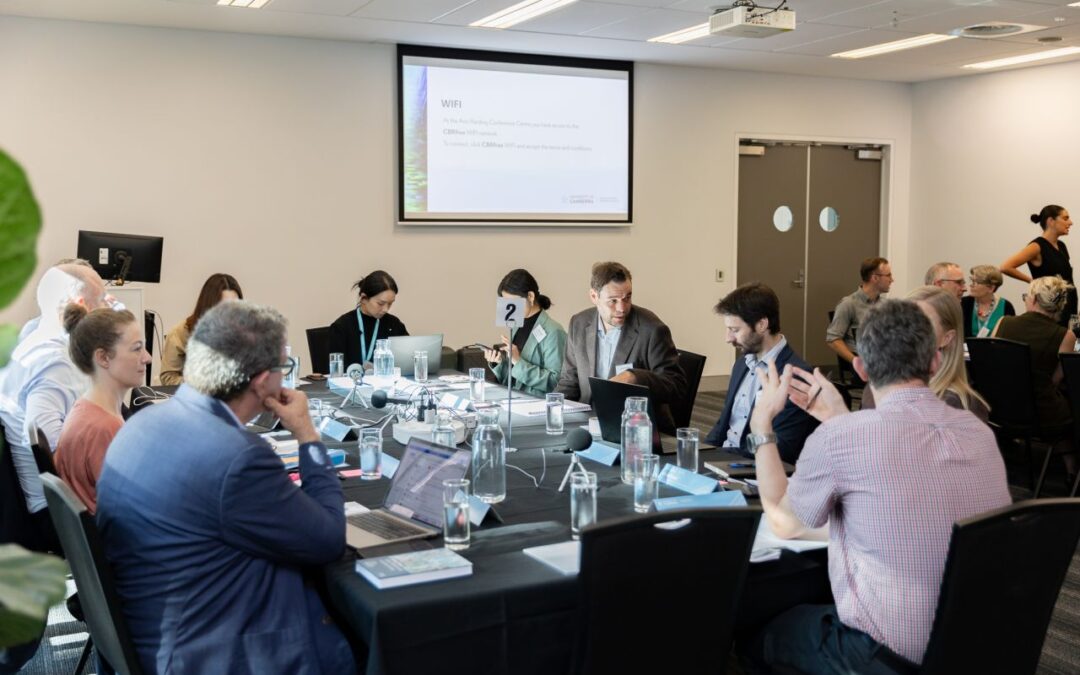
Following my participation in the Australian Local News Resilience Project in 2024, I was invited, as the CNAV President, to the News Futures: Media Policy Roundtable at the University of Canberra.
A project of the University of Canberra’s News and Media Research Centre, the half-day event was a mix of academics from the News and Media Research Centre, as well as other universities, representatives from the Federal Government, specifically the Department of Infrastructure, Transport, Regional Development, Communications,
Sports and The Arts, and representatives from the world of Journalism: The ABC, SBS, The Australian, 7News, Country Press Australia, Local and Independent News Association (LINA), and me, as President of the Community Newspaper Association of Victoria.
This may be a first for CNAV (or at least in some time), where we have been literally at the table and part of the discussion to shape future media policy in Australia.
It is, hopefully, the first of many such discussions, but we shall see.
A research paper, the basis for this roundtable, outlined research showing a growing distrust of the media in Australia, with surveys suggesting 67-71 per cent of Australians now avoid news and a decline in trust of news “brands”.
This resulted in a loss of advertising revenue and the contracting/closure of mastheads.
It is worth noting that these surveys and the data are focused on the big news brands, and often, the local and hyperlocal mastheads (like ours) are not counted in the data.
So, while it may look bad for the big mastheads, it should be noted that, generally, the small, hyperlocal publications are doing quite well.
The research paper (and current policy) often excludes smaller publishers and new media just because we are not as readily available (data-wise) or necessarily engaged in
the same way as Fairfax, News Corp, etc., but by being part of this conversation, we were able to begin the conversation about changing this, so we are represented and consulted on these issues.
Other topics discussed were the impact of AI on journalism, and policies such as the News Media Bargaining Code and the Federal Government’s Journalism Assistance Program.
Note (and I voiced this in the discussions), policies like the News Media Bargaining Code and the Journalism Assistance Fund, impact small publishers but rarely carry any benefit to us as we are often not big enough (i.e. employ full-time journalists) or structured in a way to benefit from the positive effects of these policies and grants.
This contributed to a discussion that the Federal Government recognises that the media landscape in Australia is diverse, and the measurement for identifying what journalism is, who is a journalist, and what qualifies for support needs to be broadened and redefined to accommodate publishers and new media that are falling under the radar.
We then split off into groups (pre-defined) and discussed:
- Improving engagement and trust among Australians
- Challenges and responses to AI in journalism
- Sustainability of Public Interest Journalism
The outcomes of these discussions will be released by the Research Centre once the academics have processed the conversations (they have a lot of work cut out for them), and I will share that paper with you when it is published.
I was placed in the group discussing the impact of AI, and we had a healthy and constructive discussion about the challenges newspapers are facing in terms of Transparency of the technology, trust in the technology, maintaining authenticity, accuracy, and integrity in journalism, and the environmental impact.
The discussion also touched on the more general issue of digital literacy – specifically around AI.
The general vibe was that everyone in the room shared a similar view on many of the issues discussed, which is reassuring, and you should all know that the issues we face in the newsroom are the same issues the large commercials are facing.
This Roundtable, while largely an academic exercise, did have input/interest from the Federal Government; there is hope that the eventual report will go towards shaping media policy, and support through grants and other funding initiatives, and CNAV is directly involved in that discussion, ensuring our sector of Australian media is more readily included in future developments.
There were a lot of people in a relatively small room, and one had to be heard to make an impression (ask questions and contribute with gusto) — that was achieved.
James Poyner
President, Community Newspaper Association of Victoria